


A foundation director often inherits a donor spreadsheet, a folder of untracked plaques, and a naming conversation waiting for committee approval. A practical fraternity and sorority foundation donor recognition program fixes that by doing four jobs consistently: confirm the gift promptly, document the commitment, deliver the promised recognition, and report the impact back to the donor. For fraternity and sorority foundations, the system also needs clear giving tiers, privacy controls, naming procedures, stewardship formats, chapter and household data standards, and an annual operating calendar.
Recognition is not a collection of thank-you gestures. It is administrative infrastructure that connects donor data, gift agreements, communications, events, physical gifts, and board oversight. In a Greek-letter context, that includes annual donor societies, lifetime circles, planned giving societies, chapter-house preservation campaigns, scholarship endowments, anniversary campaigns, and convention recognition. For foundations evaluating tangible commemorative formats early in the planning process, fraternity and sorority gifts can be reviewed alongside the policy, privacy, and fulfillment rules that govern the program.
What a Fraternity and Sorority Foundation Recognition Program Has to Do
The first job is confirmation. A donor should receive an accurate acknowledgment that identifies the gift, the designation, and any restrictions the foundation accepted. A generic annual letter cannot substitute for a timely process that records when the gift arrived, whether it supports a scholarship fund, chapter-house preservation effort, unrestricted annual fund, convention initiative, or endowment, and what recognition the donor selected.
The second job is documentation. Every promised benefit needs an owner and a record. That includes the spelling of a donor's name, approved honorifics, household naming preferences, chapter affiliation, society eligibility, event invitations, public listing status, and any expiration or review date attached to a recognition benefit.
Practical rule: If the benefit is not recorded in the donor system, treat it as unassigned.
The third job is fulfillment. A foundation may promise an annual report listing, a donor-circle gift, a convention reception invitation, a named scholarship, a chapter-house plaque, a centennial campaign acknowledgment, or a board service tribute. Each promise creates a production and follow-up task. Development staff should be able to see whether the item was ordered, approved, delivered, installed, or declined.
The fourth job is impact reporting. Donors need more than evidence that their names appeared somewhere. Scholarship updates, preservation progress reports, student correspondence, campaign updates, and mission reports help connect the gift to the work it supports. The format can be public or private, depending on the donor's preference.
A workable program usually has five operating components:
- Tier architecture: annual, cumulative lifetime, and planned-gift recognition with distinct definitions.
- Policy controls: written rules for naming, privacy, approvals, duration, and removal.
- Stewardship formats: communications and gifts matched to donor preference and significance.
- Annual calendar: recurring touchpoints with named owners and production deadlines.
- Measurement: operational reporting that shows whether promises are being fulfilled.
That structure matters because fraternity and sorority foundations often rely on a mix of professional staff, volunteer trustees, chapter liaisons, housing partners, and national communications teams. Without a shared system, recognition becomes dependent on personal memory.
Why Greek-Affiliated Donors Need Recognition Built Around Affiliation
Greek-affiliated alumni are not merely a subcategory of a general institutional donor file. Their connection may include a chapter, initiation era, house history, reunion cycle, family participation, volunteer service, and continuing membership in a national organization. Recognition that reflects those ties often feels more relevant than a generic alumni listing, provided the foundation does not assume every donor wants public visibility.
The participation data supports treating this constituency as a distinct donor segment. One large advancement analysis found a 10.9% giving rate among alumni with fraternity or sorority affiliation, compared with 5.5% among those without affiliation. Among alumni who graduated 15 or more years ago, the difference was 12.8% versus 5.8%. Those figures are reported in EAB's analysis of Greek-affiliated alumni giving.
A separate 2021 Gallup study found that 54% of affiliated alumni donated to their alma mater in the prior year, compared with 10% of nonaffiliated alumni. It also reported that 37% of affiliated alumni donated to their member organization or foundation. The Gallup fraternity and sorority outcomes study gives foundation leaders a useful basis for building identity-linked recognition.
| Dimension | Greek-Affiliated Donors | General Alumni |
|---|---|---|
| Primary identity | Chapter, organization, initiation history, service, and shared values | Institution, class, program, or campus experience |
| Useful recognition context | Founders Day, chapter milestones, conventions, donor circles, family participation, anniversaries | Class years, campus milestones, institutional campaigns |
| Stewardship channel | National publications, chapter communications, reunions, conventions, personal outreach | Alumni communications, institutional reports, campus events |
| Data requirement | Chapter, affiliation, initiation era where appropriate, household relationships, service history, privacy preference | Class, degree, program, contact details, giving history |
| Program risk | Over-public recognition or inaccurate affiliation details | Generic communications that fail to distinguish donor interests |
A dedicated recognition structure does not mean building a separate fundraising operation. It means adding fields and rules that allow the foundation to recognize the donor's relationship accurately. A lifetime circle may acknowledge cumulative giving, while a chapter communication highlights a scholarship, preservation project, or endowment connected to that donor's own experience.
The practical test is relevance. If the same recognition message could be sent to any donor at any institution, it probably has not used the identity assets that make fraternity and sorority foundation donor recognition distinctive.
Designing Donor Societies That Scale for Fraternity and Sorority Foundations
Tiered societies work when each level has a clear definition, a manageable fulfillment plan, and a reason for the donor to understand the distinction. Most fraternity and sorority foundations need three separate tracks:
- Annual giving societies, based on gifts credited during a defined giving period.
- Lifetime cumulative societies, based on verified giving across the donor's history.
- Planned-gift societies, based on documented bequests, endowments, or other qualifying commitments.
That structure is especially useful in Greek-letter fundraising because the same donor may support several priorities at once: annual operations, scholarship funds, chapter-house preservation, anniversary campaigns, convention initiatives, and legacy commitments.
Public fraternity and sorority examples show how broad a ladder can become. The Pi Beta Phi Foundation documents annual recognition tiers ranging from $18.67 to $25,000 and above, with lifetime circles ranging from $25,000 to $1,000,000 and above in the available program excerpt. That example is useful as a design reference, not as a threshold to copy. Review the Pi Beta Phi Foundation recognition example alongside your own donor distribution and administrative capacity.
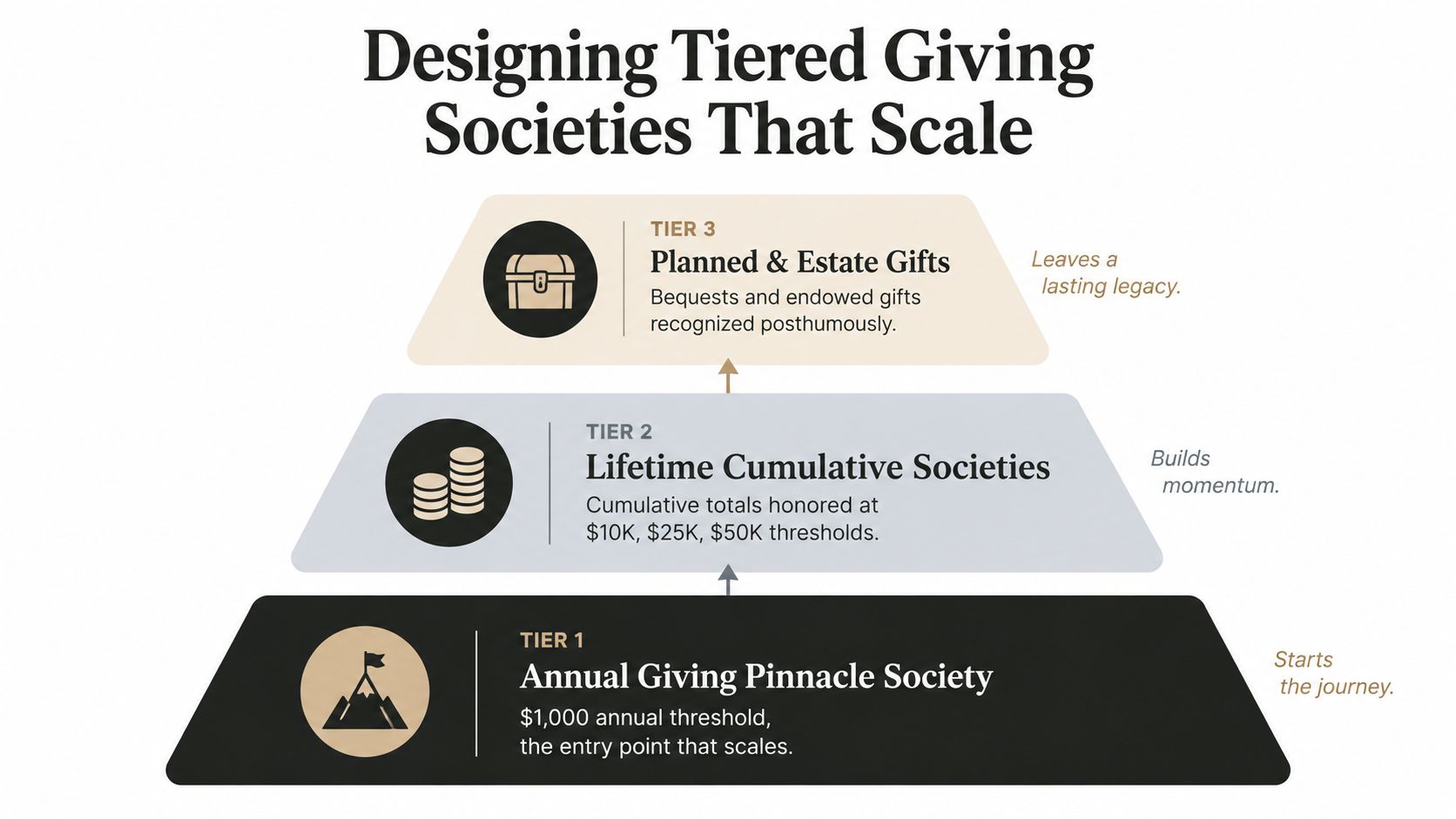
In practice, the recognition ladder should map to foundation realities, not just gift size. Examples include:
- Annual donor circles tied to yearly participation in the foundation fund or scholarship support.
- Lifetime circles that recognize cumulative generosity across many years or campaigns.
- Planned giving societies for documented bequests, beneficiary designations, or other qualifying deferred commitments.
- Campaign recognition groups for chapter-house preservation, educational space improvements, anniversary initiatives, or capital projects.
- Service-related recognition for trustees, foundation board members, campaign chairs, and long-serving volunteers whose philanthropy and leadership both shape the organization.
The deliverables should become more specific as the relationship deepens, but they should not become impossible to administer. An annual listing may be appropriate for a broad society. A cumulative milestone could trigger a personal letter, a commemorative item, or an invitation to a donor gathering at convention. A planned-gift society may require a confidential acknowledgment, a legacy conversation, and a separate honor-roll process.
Keep annual and lifetime recognition visibly distinct. A donor who qualifies for a lifetime circle should not be assumed to qualify for the current-year annual society unless the policy says so. Conversely, an annual donor should not be presented as a lifetime member based on a single gift.
Planned-gift recognition needs especially careful documentation. The foundation should define whether a revocable bequest intention, an irrevocable commitment, an estate distribution, or an endowed fund qualifies. Recognition should not be published until the commitment has been reviewed and recorded under the foundation's policy.
A tier review should examine actual giving patterns, donor movement, fulfillment workload, and privacy requests. The right question is not whether the ladder looks impressive. It is whether staff can explain it, update it, and fulfill every benefit without creating exceptions that undermine trust.
Naming, Chapter Facilities, and Gift Agreements
Naming is a policy process, not a donor perk. In fraternity and sorority foundations, that question often involves scholarship funds, endowed funds, educational spaces, chapter-house preservation projects, library rooms, leadership spaces, archives, or campaign-level recognition tied to a facility or anniversary effort. The foundation needs to know what can be named, who owns the asset, how long the name remains, what happens if the property use changes, and which approvals are required before anyone presents the opportunity.
This issue is more complex in Greek-letter settings because property and governance can be shared or split. A foundation may be raising funds for a chapter facility owned by a housing corporation, a house corporation board, an alumni association, or a related entity outside the foundation itself. That means approval sequencing should be written down before gift conversations begin.
One useful policy principle comes from the Kansas State University Foundation, which states that naming may apply to a physical or non-physical entity funded by a gift, but naming does not give the donor control over how the fund or asset is used. That distinction is highly relevant for fraternity and sorority foundations as well, especially when donors support scholarship endowments, educational spaces, or capital projects linked to chapter property. Review the Kansas State naming policy as a policy reference point.
| Naming Category | Foundation-Specific Application | Required Approvers | Gift Agreement Required |
|---|---|---|---|
| Scholarship or program | Named scholarship, leadership fund, emergency grant fund, educational initiative | Foundation staff, designated committee, board authority | Yes |
| Endowed fund | Permanent scholarship or mission endowment under foundation spending policy | Foundation leadership and board authority | Yes |
| Chapter facility or room | Library, study room, leadership room, preservation element, campaign-recognition space | Foundation, property owner, housing corporation or related governing body | Yes |
| Anniversary or campaign recognition | Centennial, capital campaign, preservation campaign, major milestone effort | Campaign leadership and governing board | Yes |
| Planned-gift recognition | Documented qualifying legacy commitment | Planned-giving staff and authorized foundation reviewer | Yes |
A development officer should not negotiate a permanent name while a board committee is still debating whether the asset can be named. Where housing corporations, chapter facilities, or shared property are involved, the foundation may need approval from parties outside its own board.
The agreement should address duration, payment schedule, use of the name, spelling, honorifics, privacy, relocation, decommissioning, program dissolution, and the foundation's right to revise or remove recognition in defined circumstances. It should also state that recognition does not transfer operational control.
Build three practical artifacts: a naming policy one-pager, a standard gift agreement template, and a board resolution form for each approved naming. Planned-giving donors also need a clear documentation path, which is why a separate planned giving society gift framework can help staff separate legacy recognition from annual society administration.
Choosing Recognition Formats That Fit Fraternity and Sorority Foundations
The right format depends on the donor's privacy choice, the permanence of the recognition, the work required to produce it, and the relationship being honored. No single format will serve an annual donor, a lifetime society member, a trustee, a campaign chair, and a donor who has made a legacy commitment equally well.
Physical installations are visible and durable, but they require accurate copy, property approval, fabrication, installation, maintenance, and a plan for future changes. Plaques, named rooms, donor walls, and chapter-house displays suit donors who have expressly chosen public recognition and whose gifts meet the foundation's naming rules. They are not appropriate as an automatic response to every substantial gift.
Printed recognition is easier to distribute across a broad society. Annual reports, honor rolls, convention programs, anniversary books, and impact publications can reach many donors, but they depend on clean data and careful proofing. A misspelled name or incorrect chapter affiliation can damage trust more quickly than a missed listing.
Event-based recognition creates personal contact, especially at conventions, Founders Day programs, reunions, anniversary weekends, scholarship gatherings, and campaign celebrations. It also introduces registration, accessibility, invitations, hospitality, speaker coordination, and follow-up tasks. An event should support the relationship, not replace the written acknowledgment that confirms what the donor gave.
Digital surfaces offer flexibility. An online honor roll, recorded tribute, or password-protected impact report can accommodate different levels of visibility. Digital recognition still needs consent tracking, accessibility review, content ownership, and a process for correcting or removing information.
Bespoke gifts are most useful when the item carries a clear connection to the donor's milestone or the organization's history. Crystal, leather goods, chapter items, and woven textiles may suit lifetime, estate, campaign, board service, or anniversary recognition. They generally should not become automatic annual gifts unless the foundation can manage personalization, approvals, packaging, delivery, and privacy preferences at scale.
Use this decision sequence before selecting a format:
- Ask about visibility: Public, limited to members, or private acknowledgment?
- Confirm the occasion: Annual participation, cumulative milestone, planned gift, campaign, named asset, board service, or anniversary?
- Check the operational burden: Who will approve the copy, order the item, deliver it, and record completion?
- Match the message: Does the format communicate impact, membership, chapter history, preservation, or personal gratitude?
- Verify the specifications: Materials, care, personalization, production schedules, and packaging vary by program and must be confirmed before commitment.
For a premium commemorative gift, begin with the recognition purpose before choosing the object. Define who is being recognized, what the milestone represents, what approved identity elements may be used, and how the gift will be presented before design begins.
For a foundation seeking a custom commemorative textile, fraternity and sorority gifts can be evaluated alongside other milestone options. Custom-woven blankets may incorporate approved organizational colors, founding dates, chapter history, physical settings, architecture, campaign imagery, or a story label, subject to design and production confirmation.
Running the Annual Stewardship Calendar
A useful calendar follows donor moments rather than forcing every activity into a generic month-by-month communications plan. The development director owns the master schedule, the communications lead owns production, and chapter, housing, or volunteer liaisons verify affiliation details and local context.
Start with the basic cycle. January can focus on acknowledgment audits and annual recognition records. Spring is suitable for scholarship recipient letters and impact updates when those stories are available. Founders Day recognition should follow the organization's own calendar, not a generic institutional schedule.
Scholarship award cycles and academic-year milestones can create natural opportunities to share recipient stories, program impact, or funded outcomes with donors. Summer outreach can reconnect newer alumni and recent graduates with foundation programs, chapter history, scholarships, or legacy initiatives. Fall conventions, reunions, anniversary weekends, and chapter gatherings may support donor receptions, milestone acknowledgments, campaign updates, or private conversations about legacy giving. Year-end communications should include accurate tax documentation and a separate stewardship message where appropriate.
Each touchpoint needs a dependency. A recipient letter depends on recipient consent and approved details. A printed honor roll depends on a locked donor file and privacy suppressions. A convention reception depends on an invitation list, registration process, event logistics, and a follow-up assignment. A physical gift depends on approved artwork, personalization data, production, packaging, and delivery.
Budget each recognition stream separately. Track acknowledgment materials, publications, event costs, digital administration, fulfillment, shipping, data maintenance, and staff time. A program that looks inexpensive on paper may become costly when staff repeatedly corrects records, handles undelivered gifts, or manages exceptions created by unclear policy.
The calendar should also include a board review of the recognition roster. Trustees need visibility into new naming commitments, privacy complaints, unfulfilled benefits, planned-gift documentation, chapter-facility recognition, and changes to society membership. That review turns recognition from a communications task into a governance practice.
Implementing the Program and Measuring What Matters
Implementation should begin with policy, not merchandise. Define the societies, qualification rules, privacy choices, naming authority, approval sequence, gift agreement requirements, and removal provisions before staff publishes a new recognition benefit.
A practical rollout has five stages:
- Finalize policy: Approve tier definitions, recognition benefits, naming rules, privacy language, and planned-gift documentation.
- Clean the data: Deduplicate records, verify gift history, confirm chapter affiliations, standardize honorifics, and record household relationships.
- Secure board approval: Present the policy, fulfillment plan, budget assumptions, and sample communications for formal authorization.
- Soft launch: Test one society with a controlled donor group before expanding to lifetime and legacy programs.
- Review the operating year: Compare promised benefits with completed benefits, donor feedback, staff workload, and financial results.
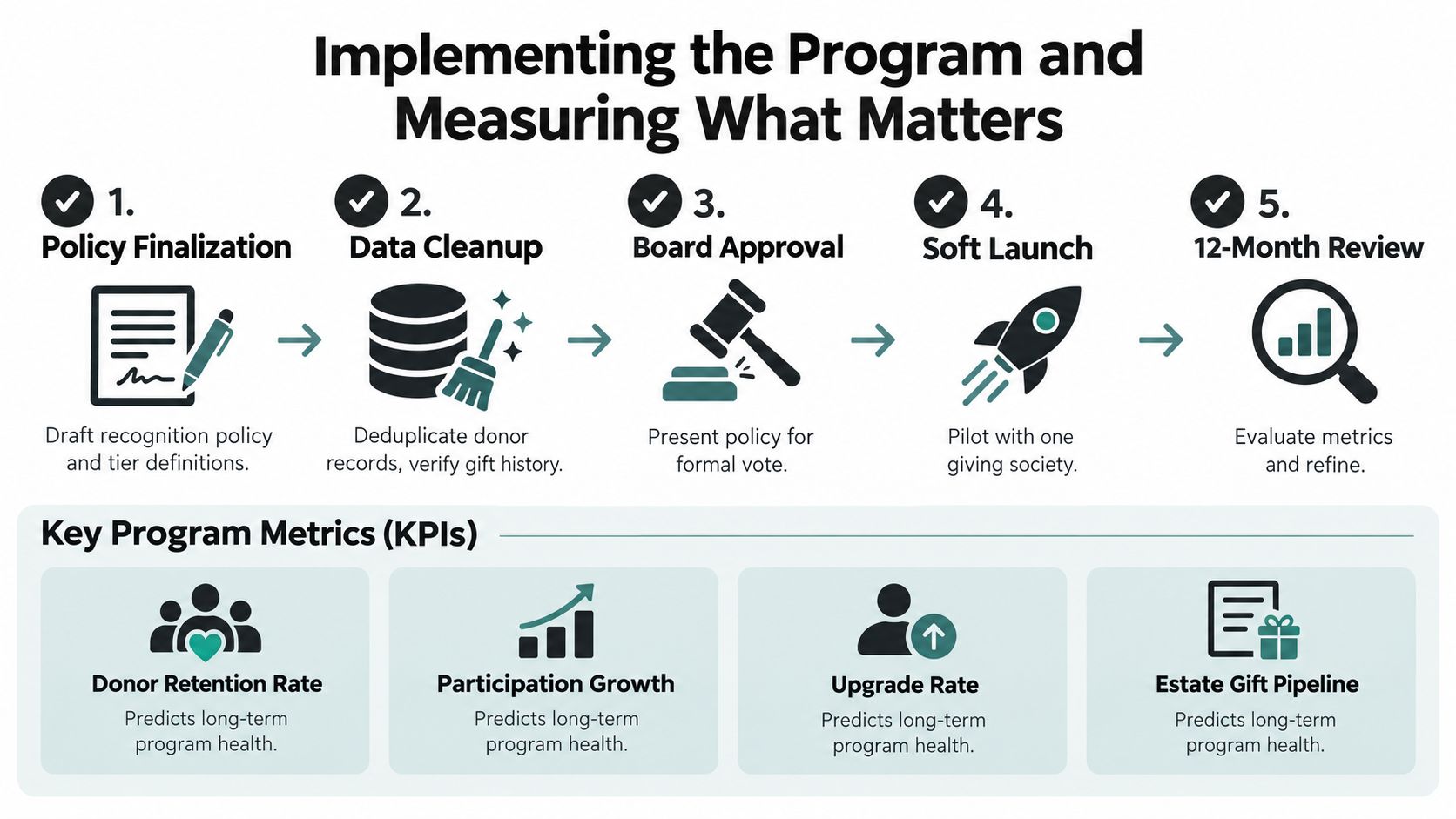
The most useful measures are operational and segment-specific. Track renewal by society, second-gift conversion over a defined follow-up period, naming fulfillment cycle time, chapter-affiliation accuracy, and honorific accuracy. Compare those results by annual, lifetime, planned-gift, chapter, campaign, and privacy-preference segments where the data supports a fair comparison.
Avoid vanity reporting. The total number of donors listed on a wall does not show whether the foundation delivered what it promised. A better dashboard includes:
- Renewal behavior: Which society members continue giving?
- Upgrade movement: Which donors move into a higher annual or cumulative tier?
- Fulfillment status: How many recognition commitments are complete, pending, or overdue?
- Data accuracy: How often do staff correct names, titles, affiliations, or household records?
- Stewardship cost: What staff and program resources support each recognition stream?
- Complaints and opt-outs: Which formats create privacy concerns or administrative friction?
The four jobs remain the standard: acknowledge the gift, document the commitment, fulfill the promise, and communicate impact. If the foundation can demonstrate those actions with accurate records and consistent review, its recognition program is functioning as a system rather than a collection of ceremonial extras.
Frequently Asked Questions
What should a fraternity or sorority foundation recognize?
Recognize annual participation, cumulative giving, planned or estate commitments, campaign support, scholarship support, chapter-house preservation, anniversary initiatives, board or trustee service where the policy allows it, and approved naming commitments. The foundation should define each category before publishing donor lists or offering benefits.
Should every donor receive public recognition?
No. Donors should be asked whether they prefer public, limited, or private recognition. Privacy choices need to be recorded and applied consistently across reports, websites, event materials, and physical displays.
Does a naming gift give the donor control over the asset?
It should not. Recognition and control are separate. A gift agreement should state the donor's recognition rights while preserving the foundation's authority to administer the fund, program, or property according to its governing documents.
When should a foundation use a bespoke donor gift?
Use a bespoke gift when the occasion and donor preference justify the additional design, approval, production, packaging, and delivery work. Lifetime, campaign, board service, anniversary, and estate recognition are usually more appropriate than automatic distribution to every annual donor.
Does every naming opportunity require a formal agreement?
A foundation should require a written agreement for every naming opportunity, especially where chapter facilities, housing entities, campaign spaces, endowed funds, or scholarship commitments are involved. Verbal commitments create unnecessary risk.
For fraternity and sorority foundations planning donor, board, anniversary, campaign, or legacy recognition, explore Ecuadane’s fraternity and sorority gifting programs or start a custom design discussion for a recognition program that fits your foundation’s policy, privacy, and fulfillment requirements.